
Amid academia’s focus on learning and knowledge, it can sometimes be easy to forget that for most people, knowledge and learning are not goals in and of themselves, but merely means towards an end. More often than not, the purpose of learning is to be able to apply knowledge towards a greater goal. Unapplied knowledge is akin to a library filled with books that no one is allowed to read. Similarly to a book in such a library, unapplied knowledge is useless—serving no purpose other than that of its own existence.
Towards this end, it is important to understand not only the whats and hows of a subject, but also the whys. One can typically describe a problem so long as they know what it is; and one can complete a process if they know how to do it. However, it is the why which allows one to go beyond describing a problem to determining its cause and identifying the process by which it can be solved. Often one can make do solely by memorizing problems, or whats, and the processes, or hows, that provide the corresponding solutions. But this creates only a facade of skill that is betrayed by a lack of adaptability. Think of a chess player whose knowledge of chess consists entirely of memorized chess puzzles. So long as the state of the board matches with that of a puzzle he knows, he can play like a master. However, when faced with an unfamiliar situation he will be left at a loss as to what move he should make. In contrast, a player who understands the theory and reasoning behind chess strategies can adapt and form their own stratagems.
This concept is true for many fields of study, however the instances where this was taught in my Calculus I class (MATH 141) come foremost to my mind. The core concepts of calculus are the operations of differentiation and integration. Differentiation describes the slope of a function at any singular point in its domain. The derivative of a function f(x) can be is given by the formula
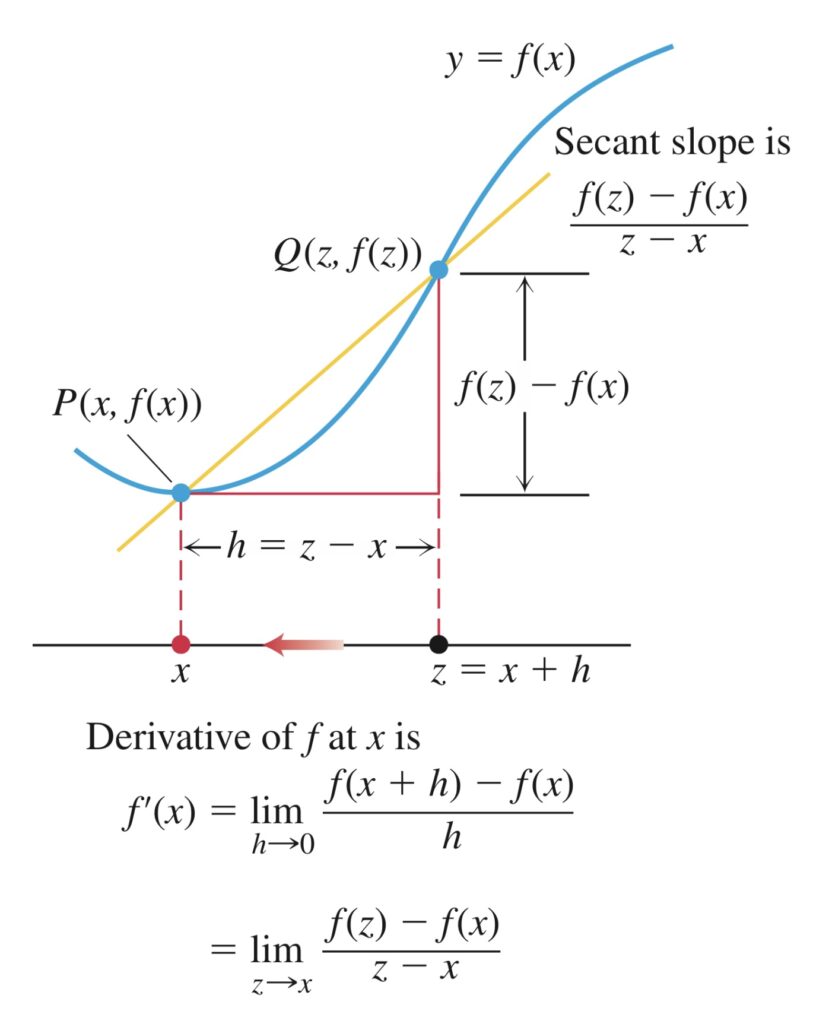
(See also the version in my notes.)
(shown graphically in the illustration). It is shown why the derivative equals its definition by the concept of a secant line through two points, one of whose values tend towards the other’s as h approaches 0. We also were taught why differentiation could be described as the rate at which a function’s rate of change changes. Because the value of each point in f’(x) at x = a will be equal to the slope of f(x) at x = a, f’(x) is a function representing the rate of change in f(x). Similar proofs were taught showing why integration is defined the way it is.The definitions and reasoning behind differentiation and integration were specifically emphasized in the class and showed up on nearly every exam in the class.
The importance of these concepts above others taught in the class is that they are the why behind everything else in the class. While most of the time in class may have focused on the hows involved in complex problems, understanding the why is crucial in knowing when to use integrals and derivatives to describe real-world relationships. Only when you understand that the derivative describes the time/rate change in a function do you realize that velocity can be described and calculated as the derivative of position with respect to time. Without an understanding of the nature of the mathematical operations (the whys), they have little value beyond the paper they are written on. At best, one might be able to apply them to the real-world using formulas describing the relationships someone else determined, but unable to apply the concepts independently.

This is an example of one of the more complex Minecraft redstone builds. The red lines on the front two green and pink blocks are redstone dust, which form the basic wiring of each build. Also visible are repeaters, comparators, redstone torches (power sources), dispensers, hoppers, programming blocks, and pistons. These were all commonly used in the builds students learned at camp.
This was also seen in my time teaching during USCL’s summer arts and science middle school camp. One of the major activities involved teaching the participants the basics of circuitry and programming through Minecraft’s redstone mechanic. Using the capabilities of redstone, we taught participants first how to build simple circuits, and then worked our way up to more complex builds with randomizers, triggers, clocks, and more. While the demos we built were cool, the most important parts of the class were the explantations of why each build functioned the way it did. While every student could complete the preset builds by mimicking the demonstration, many were unable to build complex builds on their own as a result of only copying the demonstration without bothering to understand the logic of why it worked. The most successful participants were those who paid attention as we explained the underlying whys behind the different mechanics we introduced, and were thus able to use the concepts to create complex original builds of their own.
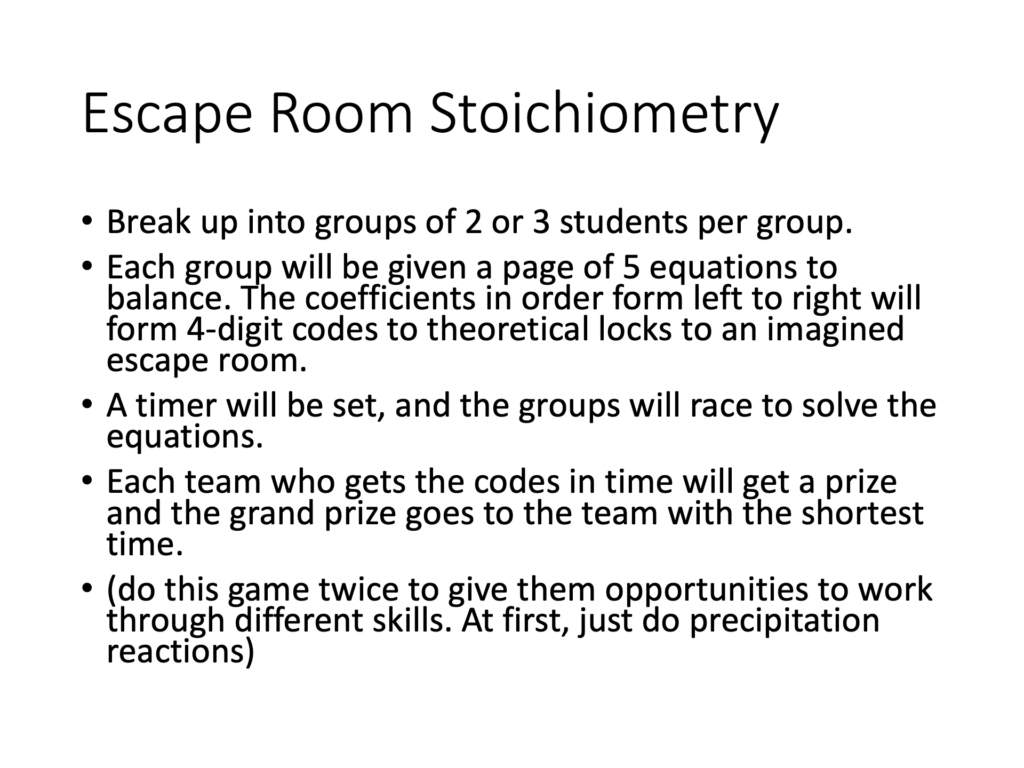
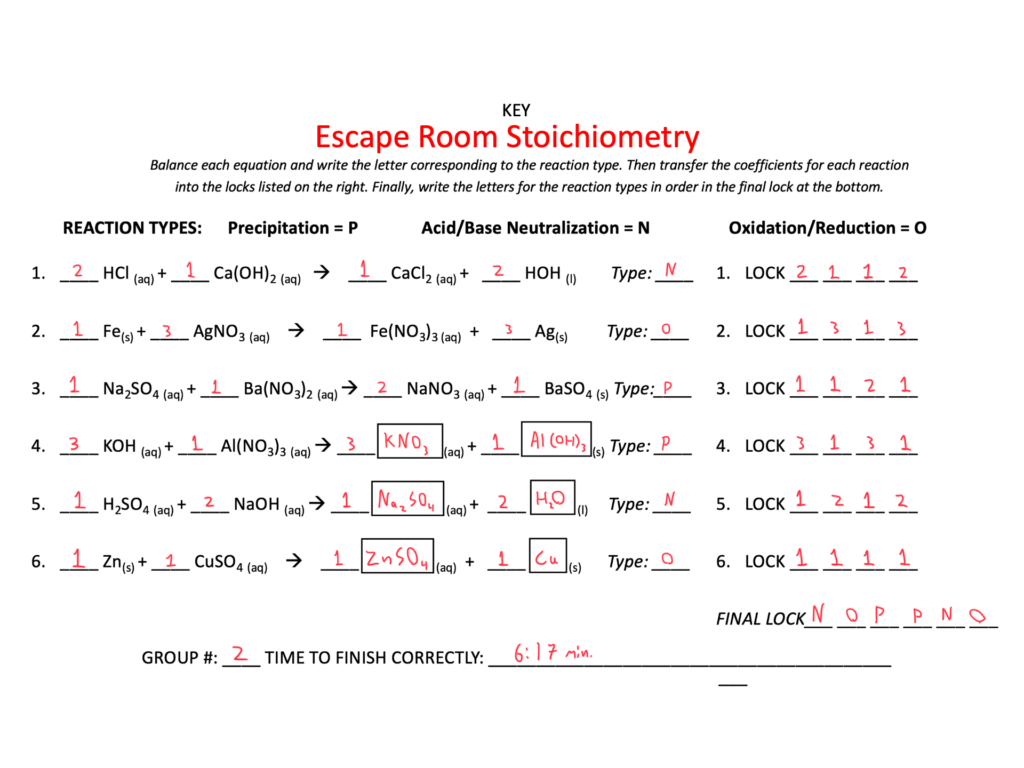
Trying to understand the why behind a what is also essential in most types of research. The research project I undertook together with Dr. Obi-Johnson is no exception. Many students struggle with the concepts taught in General Chemistry I (CHEM 111), and our goal is to provide methods for helping students to succeed. Before we can implement solutions, however, we first must have an understanding of why students struggle in the class. And without previous data to inform us, we turn to the scientific method to approach the issue. The steps of the scientific method are to observe, hypothesize, experiment, and then determine whether the data support the hypothesis or not. Ultimately, one of the main purposes of the scientific methods is determining the why behind a what. If one’s hypothesized why is correct, then one ought to be able to make predictions based upon it, which can be tested experimentally. The hypotheses we formed to explain students’ struggles with the class (the why) allows us to implement solutions that target possible causes. Observing the results of our attempted solutions will then help us to determine how accurate our hypotheses are.
Understanding the why behind the what is key in learning. Without understanding the whys behind the concepts and frameworks one learns, one will have trouble adapting and applying them to real world situations and problems which differ from the conditions one is familiar with. A memorized what provides an inflexible type of knowledge that has limited use outside its original context. The why goes beyond the what, producing a more flexible type of knowledge that can be generalized and applied to problems one has not yet encountered. As a result, whether it is in class, research, or any other type of learning, it is important to understand not only the what and the how, but also the whys.